Members Insights
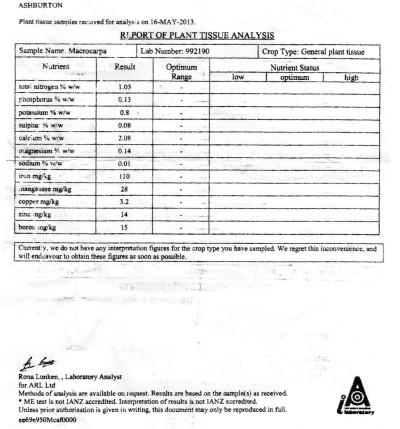
Macrocarpa foliage tested
We had some macrocarpa foliage tested in 2013 by Canterbury University for trace elements but neither they nor anyone else seems to be able to tell us what those levels should be. Can anyone at NZFF have a crack at it? I sent a copy off to Bernard Egan as well at the Ashburton branch, I believe they are still chewing on it.
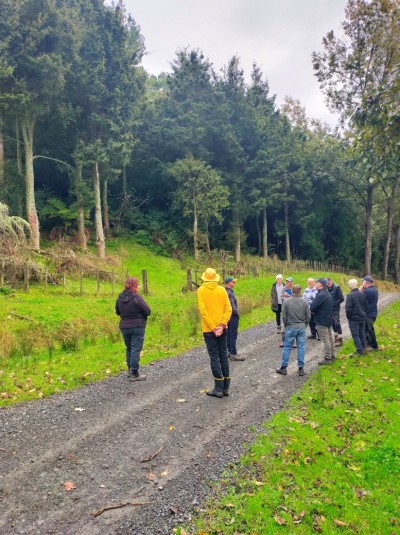
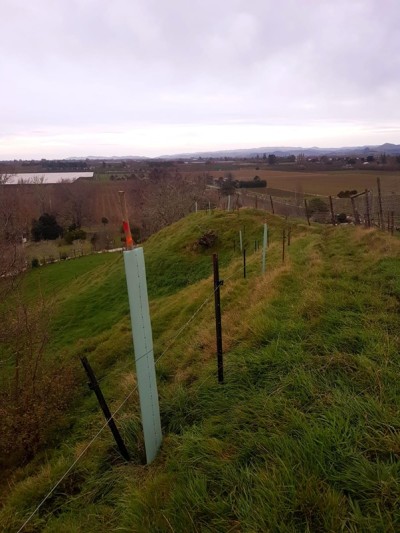
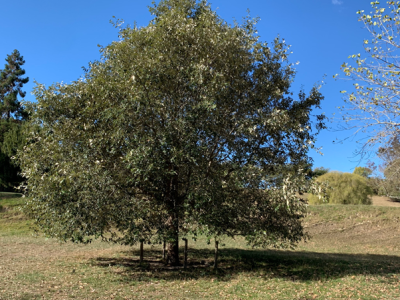
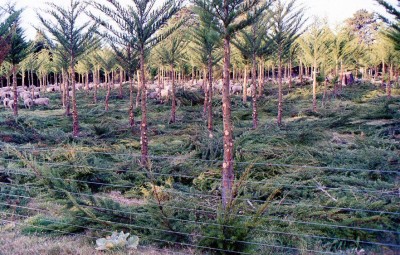
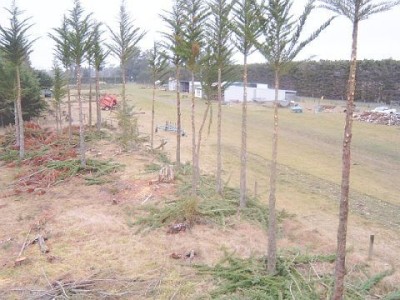
Also a couple of photos of macrocarpa we had planted over 30 years ago that are largely still standing, the Norwester has taken its toll on a few, we put the sheep on the prunings deliberately to see how many aborted, none did. They were also back on them closer to lambing as part of their drenching routine, it was used as a holding paddock, repeat, no abortions, whats going on?
I did both pruning lifts myself, they are somewhat larger now than then.
Regards Richard Langdon. 0274087008.
Eucalypts blown down
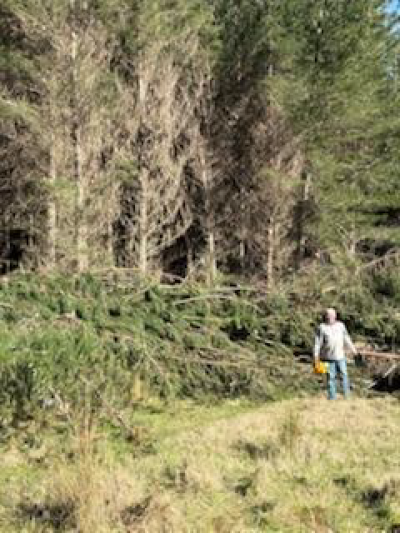
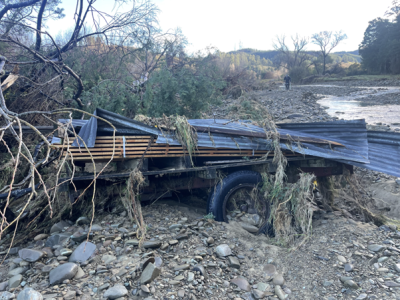
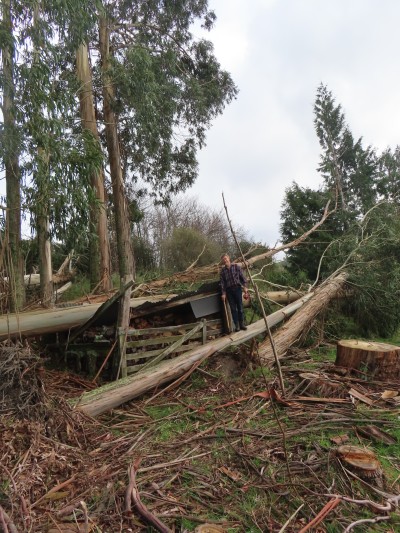
Below photo shows 9, 30+m tall eucalypts at our property near Brightwater, blown down during the second Nelson Tasman storm last Friday (11 July) and squashing an old woodshed. I was surprised just how small the root balls are on these gums, which we think are mostly E. Nitens
Regards
Andrew Fenemor
Before the fire restrictions
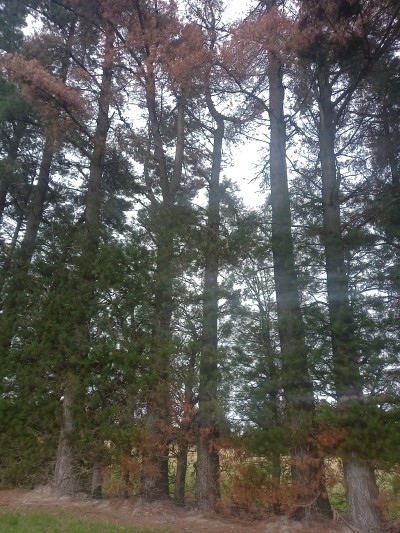
Last summer just before the fire restrictions went on, I had a burn pile jump into a single row 33 year old pine hedge that had been trimmed as hard to the trunks as possible with out damaging the trunks, and as high as the hedge cutter could reach. This system gives the porosity needed for good shelter and has proved to be more stable in wind events
The fire burnt it self out due to lack of fuel in 16 metres, only damaging the bottom 1.5 metres and the trees are alive and fine.
Time and time again I see the results of a fire getting into a classic (useless) canterbury wide topped hedge needing the fire brigade and diggers resulting in dead trees and ruined fences.
Note, these single row trimmed pines, are from part of a 46 acre block , seen over 700 tonnes of export and local logs leave the place.
Cheers Mike Davies
Hororata, Canterbury
Feral species or introduced animals
Following years of "wondering on the what if's? the how's and finally maybe's..." I have decided to see if there is interest in or within the Farm Forestry Assoc. how many of us record the number of feral species or introduced animals that now we see significant detriment to our assets we own.
I first noticed numbers during COVID times, as feral deer, feral goats, and yes even in one case ostriches not only increasing, but also becoming more bold with their movements. This of course was due to less traffic due to the government's recommended "Lock downs".
We all could have an opinion on the effects of the "lock downs" on the forestry contracting sector, and or the almost blatant confusion with what was "an essential industry", but, lets for now focus on the effects of what has happened.
I believe there could be a symbiotic relationship with both NZFFA, New Zealand Farm Forestry Association and the NZDA, New Zealand Deerstalkers Association.
Having seen the effect of feral species eating newly planted pines as an example, and seeing first hand the loss in the back pocket in both the costings in pest control/eradication, and also the ntrolled numbers now increasing. I feel now as a way to get back on top of the feral species numbers in both North and South Islands, but with some more certainty than previously shown.
By controlling the numbers we would be able to then gage the actual numbers, as in have a more certain number that would be able to be kept within a more realistic perabular.
Currently the numbers are at best guessed by, and the variety of species has also been added to by the "dumping of animals" that some within rural communities have not been able to sustain.
Some examples of added to species include:
- Kune kune pigs
- Deer both Red and Fallow species
- Goats, a larger than expected range of species including angora, and more exotic goats
- Sheep
- Cows
- Ostriches, I bring this to your attention as I have first hand experiences with a local "lifestyle farmer", having released his 10 breeding pair/s of Ostriches when he sadly commited suicide...
I have not included possum in this as there is more than enough energies going into this species with the introduced "pest free" movement including stotes, wesels rats, and feral cats.
We hear of the feral pig numbers taking over such areas as Central Otago, and the Maniototo, and further down towards greater Southland, with farmers seeing the number increase during lambing or calving season.
But, do Agriforesters really take count?
Id like to have feedback from any or all members that have notice numbers increasing, or if they have an issue or a problem....
I am also approaching the NZDA, as a collective to see if there is another way to monitor, as these guys and girls are more often out there on some forestry blocks and witnessing this first hand...
My proposal I am presenting them will also see hunters make a record of the:_
- Species
- Age, rough estimate
- Location
- and number s observed with the culled animal.
There is a similar model in place and has been highly successful in monitoring the feral species in Europe for many years, and theres a register which shows the person who has culled the animal, limiting the number of poachers, and reducing the effects of poachers on Agroforestry land/s, which also poses problems, such as:
- break ins to forestry offices
- the risk of poaches having non lawful egress through properties
- the risk of death or injury from those not knowing who is on the property with a firearm
There is a grant within NZDA to help with the setting up of this initial stage of "asking" and gaining a "lay of the land", with getting help from NZFFA.
This study could see, if successful, the numbers of feral species causing detrimental impacts on Agroforestry, and the costings of their impact on Agroforestry being more controlled, meaning less costings of pest control, a more regulated egress on private land/s, and more education for both NZFFA and NZDA.
Rob "Weta" Clark
Clark Acreage Ltd
0277688601
Timber Engineering Conferences
I attended the World Conference on Timber Engineering in Brisbane, June 23 to 26.
1000 delegates, 10 parallel sessions.
Key points:
- There are many exciting timber buildings going up around the world.
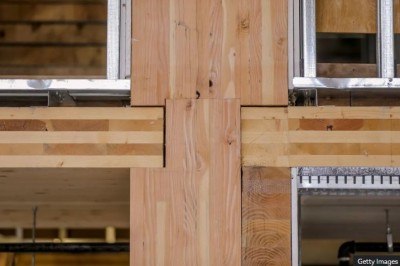
- These buildings use wood of many different species, most of it glued into “engineered wood” products.
- Sawn timber is glue laminated into beams and columns, or huge panels of CLT (Cross Laminated Timber). Thinner veneers are laminated into sheets of plywood or LVL (Laminated Veneer Lumber).
- Specialist topics at the conference included durability, fire safety, sustainability and fastening systems.
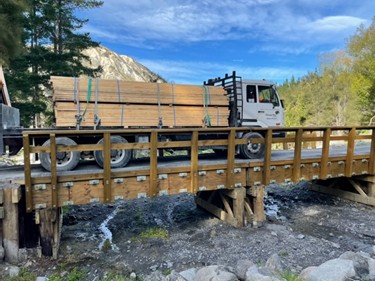
This was followed by the International Conference on Timber Bridges in Rotorua, June 29 to July 2.
150 delegates, one or two parallel sessions.
Key points:
- Many countries have historic timber bridges which are being restored or re-furbished.
- Durability is achieved either by chemical treatment, or by using roofs or decks to keep rainwater off the timber structure.
- Some spectacular timber bridges are being built in Europe and North America.
- Key topics include standardisation and cost competitiveness.
- New Zealand has a lot to learn.
Andy
Dr Andy Buchanan
Professor Emeritus, University of Canterbury.